


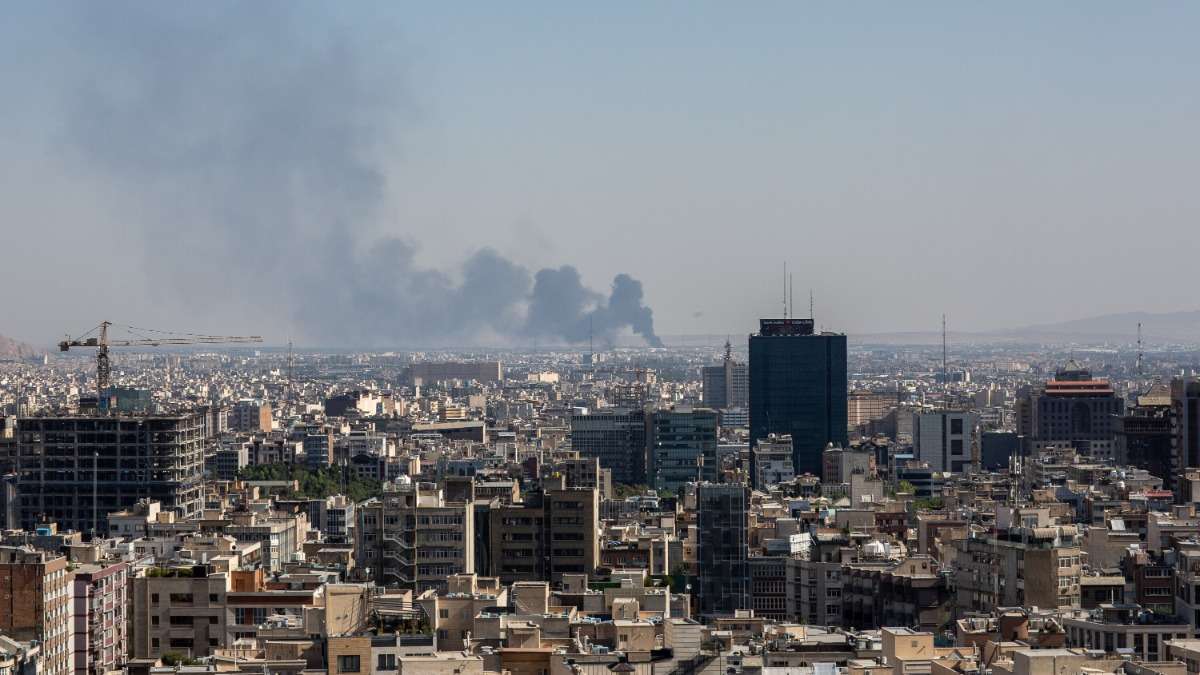
March 2, 2026. Day three.
And the question is no longer how this started. It's whether anyone has the power to end it.
Two days before the bombs fell on Tehran, diplomats were still sitting across tables in Geneva. A third round of US–Iran nuclear talks had just concluded, with mediator Oman describing significant progress and more discussions scheduled for the following week.
The ink was barely dry on that optimistic statement when the United States and Israel launched Operation Epic Fury and Operation Roaring Lion simultaneously on February 28, striking Iran's military infrastructure, its nuclear facilities, and its leadership, killing Supreme Leader Ali Khamenei in the opening salvo.
The talks were not a failure of diplomacy. Looking back at the sequencing, they may have been cover for it.
Russia's deputy security chief, Dmitry Medvedev, accused the United States of having used the nuclear negotiations as a deliberate screen before launching military operations. Whether or not that is true, the timing is the kind of thing that every government in the world is quietly noting and filing away for future reference when Washington next invites them to the negotiating table.
Three days later, the region is on fire in ways that no single map can capture.
What Has Actually Happened
The operation was aimed explicitly at regime change. That is not a characterization or an interpretation ,it is what the US and Israeli governments said publicly.
Trump framed it as eliminating what he called an intolerable threat, stating that Iran could not continue to arm, fund, and direct terrorist armies outside its borders.
The operation achieved its stated targeting objectives.
Iran declared 40 days of mourning and a seven-day national holiday. The Supreme Leader was dead. Much of the country's senior military and political leadership was killed alongside him.
What followed was not the collapse the planners appear to have hoped for.
Iran's foreign minister suggested that Revolutionary Guard units were acting independently of central government control, following pre-arranged instructions.
That sentence should stop every reader cold.
What it means in practical terms is that Iran's retaliatory capacity was designed to survive decapitation. The missiles and drones that have been hitting Gulf states for three days are not being directed from a command center that can be negotiated with or struck into silence. They are running on pre-programmed logic, activated by the death of the leadership that built them.
Iran has struck Saudi oil infrastructure, US military bases near Erbil in Iraq, a German Bundeswehr field camp in eastern Jordan, and sent drones toward Qatari airspace that a British RAF Typhoon had to shoot down.
It hit Amazon Web Services data centers in the UAE and Bahrain. It struck the US 5th Fleet headquarters in Bahrain. It sent missiles toward Prince Sultan Airbase and King Khalid International Airport in Saudi Arabia.
The geography of this retaliation is not random. It is a systematic attempt to make the entire Gulf ungovernable as a theater of American military operation.
On day three, Hezbollah entered the war, firing missiles and drones at an Israeli army base south of Haifa in revenge for Khamenei's killing—breaking a ceasefire that had held since November 2024 and opening a second front that Israel now has to manage simultaneously.
Lebanon's prime minister convened an emergency cabinet meeting and announced a total ban on Hezbollah military activities, demanding the group surrender its weapons to the state.
That is a significant political moment. It is also a demand that has approximately zero enforcement capacity behind it.
The Diplomatic Picture Is Splintering in Real Time
The international response has fractured along lines that reveal exactly how isolated Washington has become in pursuing this operation.
UN Secretary-General António Guterres stated that the use of force by the United States and Israel against Iran—and Iran's retaliation—undermine international peace and security, calling for an immediate ceasefire and a return to negotiations.
The head of the International Committee of the Red Cross warned that widening hostilities are putting civilian lives in grave danger and that the scale of military operations risks pulling the region into a large-scale armed conflict that will overwhelm any humanitarian response.
Spain's prime minister rejected the unilateral military action outright, calling it an escalation that contributes to a more uncertain and hostile international order.
Ukraine's Zelensky, meanwhile, supported the strikes, drawing a direct line to Russia and arguing that American resolve weakens global criminals everywhere.
The fact that Kyiv and Madrid are now on opposite sides of this tells you something about how comprehensively the Western alliance has been fractured by three days of bombs.
Oman, which spent months building the diplomatic channel that was supposed to prevent this war, is now simply urging Washington not to get further sucked in—a remarkable statement from a country that was Washington's key broker just 72 hours ago.
Iran's foreign minister told Oman's foreign minister that Tehran is open to serious efforts at de-escalation.
That signal exists.
The problem is that the mechanism for receiving it on the American side is unclear when Trump's own public position is that Iran's new leadership wants to talk, but he hasn't decided when he'll respond.
The Succession Vacuum at the Worst Possible Moment
This is the part that keeps serious analysts awake.
The regime change objective assumes that removing the existing leadership creates space for something better to replace it. The actual situation on the ground is that nobody knows who is making decisions in Tehran right now—including, apparently, the people who are making them.
Iran's foreign minister indicated the Revolutionary Guard was acting on pre-arranged instructions rather than current commands.
Hassan Khomeini, grandson of the Islamic Republic's founder, was urging citizens into the mosques and streets, invoking the imagery of Imam Hussein.
He carries enormous symbolic weight and essentially no institutional power over the security apparatus.
The clerics, the Guards, and the remnants of the civilian government are all simultaneously trying to position themselves for whatever comes after, while the missiles keep flying on autopilot.
A power vacuum in a nuclear-threshold state with an active war machine does not resolve cleanly.
The history of decapitation strikes—going back to Iraq in 2003, to Libya in 2011—suggests strongly that removing a government without having a functional replacement ready produces not stability, but prolonged, lethal instability that is significantly harder to end than the regime it replaced.
The difference here is the scale of the military capacity that is now operating without clear political direction.
The China Dimension Nobody Is Discussing Loudly Enough
In less than two months, the United States has effectively eliminated two of Beijing's closest strategic partners.
Venezuelan President Nicolás Maduro was seized in January. Now Khamenei is dead.
Iran and Venezuela together accounted for roughly 15 percent of China's oil imports. Nearly all of Iran's oil exports went to China.
Beijing is now facing a material disruption to its energy supply at a moment of already significant economic pressure.
China's Foreign Minister Wang Yi called the attack unacceptable and condemned what he described as the blatant killing of a sovereign leader and the incitement of regime change.
One Chinese national has been killed in Tehran. Three thousand Chinese citizens have been evacuated.
And the Strait of Hormuz the chokepoint through which China needs oil to flow—is now under Iranian threat of closure.
The question of when Beijing's response moves from diplomatic statements to something more tangible is the central question of the next several weeks.
China has more leverage over the outcome of this war than any other external actor except the United States itself, and it has every economic and strategic incentive to use that leverage in ways that do not favor American objectives.
What the Civilian Cost Actually Looks Like
Over 100 students were killed at a girls' elementary school in Iran. Three US service members are dead in Kuwait.
At least 10 Israelis have been killed and more than 200 wounded. At least 31 Lebanese have died in Israeli strikes on Beirut and southern Lebanon.
Three people died in the UAE from Iranian retaliation strikes.
Those are the numbers after 72 hours.
Trump's estimate is that this lasts four to five weeks.
Thousands of passengers remain stranded across Gulf airports, with Dubai International the world's busiest airport for international travel only beginning a limited resumption of flights on Monday evening after three days of closure.
The disruption to global logistics that runs through the Gulf from oil shipments to digital infrastructure to air freight is already being measured in billions.
Over four to five weeks, that number becomes something that reshapes global economic assumptions.
What Africa Must Understand Right Now
The oil price shock that opened markets this morning is not an abstraction for the continent.
Countries across Africa that import petroleum are looking at fuel cost increases that will pass immediately into food prices, transport, electricity generation, and the cost of running every hospital and water treatment facility that keeps people alive.
This happens before any diplomatic resolution is in sight.
The Suez Canal, through which a significant portion of Africa's trade with Europe moves, is at the northern end of an active war zone.
Shipping insurance on those routes was already elevated. Today, it is substantially worse, and the costs pass directly to African importers and exporters who had no say in the decisions that created this situation.
Millions of African workers across the Gulf in the UAE, Kuwait, Qatar, and Saudi Arabia are caught in a war that was not theirs.
The remittance flows that quietly underpin the economies of Ghana, Ethiopia, Uganda, Zimbabwe, and many others run through financial systems that are currently being disrupted by a conflict their governments had no hand in and no warning of.
The African Union, along with most Global South governments, has been essentially absent from the international conversation about how to stop this.
That absence is a structural problem.
The countries whose civilians are dying, whose oil prices are spiking, whose stranded workers are sheltering in Gulf apartments listening to missile interceptions overhead, they are not at the table where the ceasefire, when it comes, will be negotiated.
That has to change.
Not as an aspiration for the next crisis, but as a concrete demand for this one.
The AU needs to be speaking with one voice loudly in New York and Geneva, and it needs to be saying something more substantive than the standard calls for restraint that everybody issues, and nobody heeds.
Where This Goes
The ceasefire signals are there.
Oman is still mediating. Iran's foreign minister has indicated openness to de-escalation. Trump has said the new Iranian leadership wants to talk. Turkey's Erdo?an is calling for an end to the bloodbath and has offered to help broker a ceasefire.
These are real openings.
They are also competing with a Revolutionary Guard that may be operating on pre-programmed retaliation logic, a Hezbollah that has just broken a 16-month ceasefire, an Israeli government under domestic pressure to finish what it started, and an American president who has said publicly the war will last four to five weeks and has tied his credibility to seeing it through.
The honest assessment is that a ceasefire within days is possible.
A ceasefire that holds is considerably harder.
The underlying architecture that produced this war, the nuclear question, the proxy network, the Gulf security arrangements, the question of Iranian governance after Khamenei, none of that has been resolved by three days of bombing.
It has been complicated.
The world on the morning of February 27 was dangerous and unstable.
The world this morning is the same with considerably more fire in it, considerably more mistrust between the major powers, and considerably more civilian dead.
How we get from here to something navigable is the most important question in geopolitics.
Nobody who has the power to answer it is currently being straight with the rest of us about how difficult the answer actually is.


Join WhatsApp Channel
Stay connected with the latest news, updates, and exclusive content by joining our WhatsApp channel! Join now and never miss an important update from DailyPress!
 DailyPress